Monday, 4 May 2020

Albert camus's The Plague


Hello Readers,

As we know that at every point of time everything is changed by chance, force or naturally. May it have a longer effect on human life. Which you can scarcely imagine and rage the likes of which you would not believe.

Therefore lots of horrible phenomena which happened in the past that always live in our memories. That is what literature always keeps. Literature connects the entire world to what was the past and present, may it predict the future. That is why the past always remains present in every sheds of life in different shapes.

In the present situation the COVID-19 pandemic, as in all crises, brings out the best and worst of humanity. There is heroism and perfidy, complacency as well as discontent and cynicism; despair, anger, and fatalism. All told, individuals exhibit a wide spectrum of emotions, mindsets and attitudes toward a distressing event such as the present pandemic now sweeping the globe. As like 

Read. Read. Read. Just don't read one type of book. Read different books by various authors so that you develop different styles.

                               - R.L. Stine

Because all have different perspectives to look at the things. Here in this blog I have written about the overall effect of plague and how it is portrayed by Albert camus in his book "The plague" (La Peste).


Albert camus 
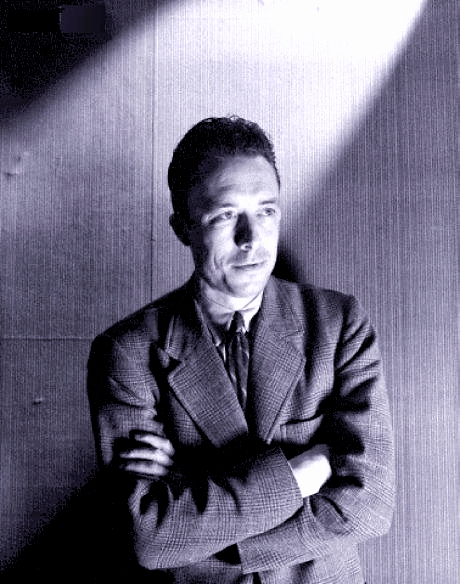
Albert Camus was French philosopher, author and journalist. Camus was born on 7 November 1913 and died on 4 January 1960. He ignored systematic philosophy, had little faith in rationalism rather than argued the main Idea he accepted the Aristotelian  idea that philosophy begins in wonder.

The plague 


The book "The plague" which hauntingly captures the varying responses and struggles of people in today’s societies. La Peste portrays characters as they struggle against the plague (the Bubonic plague) sweeping a city in Algeria called Oran. Although a fictionalized piece of literature set in the 1940s.

The Plague is believed to be a depiction of true events in the coastal city of Oran, Algeria which has been decimated by intermittent outbreaks of cholera throughout its long history.

Video - 1


when thousands of rats suddenly  begin to die on the streets of Oran. As the populace begin to notice the unexplained deaths, hysteria develops, and the rats fear the spread of bubonic plague.

As more and more people fall ill and die, the town is sealed off, gates are shut, rail travel prohibited, and all mail service suspended. In today’s lingo, Oran was put on enhanced community quarantine.

The whole oran is covered with the struggles, their pains, despair and finally redemption. Camus’ characters mirror our own attitudes and responses towards the current coronavirus pandemic.


Dr. Rieux sees that many are falling ill and dying helplessly, and decides to devote all his expertise as a doctor to alleviate the suffering of the victims. Like the same nowadays doctors are paying their valuable time and duties for coronavirus affected patients to recover.

Humanity and self centredness 

camus's of upheld in the novel The plague and makes a study of a major character to prove that they are existentialist in Heideggerian and sartre rain themes of death, alienation and a bad faith.


Furthermore it studies how the characters in the novel are inclined to deny the cruelty of their condition and hide themselves in their illusory world governed by habit.

Camus presents a contrast in the novel between the Spiritual and Mundane in life and focuses on the vision of a better society. which is based on human values. it studies the existential anguish and the cries, through characters such as dr.Rieux, Father Paneloux, Rambert ,Tarrou and cottard.

Camus's writing The Myth of Sisyphus is dedicated to establishing conscious recognition of the absurd. The purpose of The Myth of Sisyphus is to determine whether suicide is a logical reaction for the man who realises that life is absurd. The discovery of this absurd or a meaninglessness leads one to revolt, which replaces empty forms with authentically significant acts. In The Plague the notion of absurdity is presented as a collective experience. 

Conflict of Religion and science in The Plague 


Camus juxtaposes medicine against government and religion in his quest to find medical meaning in an absurd world.

The perfect shelters himself from responsibility, other townsfolk find solace in religion. Camus again distinguishes individuals from societal groups—this time, religion rather than government. The townsfolk, as to be expected, are slow to religious action as long as they can deny the plague’s existence in its early stages.

Town resolved to do battle against the plague with the weapons appropriate to them, and organized a Week of Prayer.

In the advancement  of science the meaning of medicine in an absurd world, Camus paints Oran as “a town without intimations; in other words, completely modern”, “Modern” at the time of Camus’ writing of this novel would refer to the technological advances moving to the forefront of medical practice, as well as the concomitant isolation of the patient within such a sterile system. 

Indeed, Camus describes the alienation of the ill in such a “completely modern” town as a metaphor for how a dehumanized society can isolate patients trusting.

Epidemic Literature 

Here l mentioned the whole historical epidemic which has a deep impact on the literature.  It always remains present in the literature and plague or other epidemic raised the writing advancement of writer

Prehistoric epidemic:circa 

3000 B.C.

Plague of Athens 

430 B.C.

Antonine plague 

A.D. 165 - 180

Plague of cyprian 

A.D. 250 - 271

Plague of justinian 

A.D. 541 - 542

The Black Death 

1345 - 1353

Cocoliztli epidemic 

1545 - 1548

American plague 

16th century 

Great plague of London 

1665 - 1666

Great plague of Marseille 

1720 - 1723

Rassian plague 

1770 - 1772

Philadelphia yellow fever epidemic 

1793

Flu pandemic 

1889 - 1890

American polio epidemic 

1916

Spanish flu 

1918 - 1920

Asian flu

1957 - 1958

AIDS pandemic and epidemic 

1981 - present day 

H1M1 Swine flu pandemic 

2009 - 2010

West African Ebola epidemic 

2014 - 2016

Zika virus epidemic 

2015

Friday, 13 March 2020

Views on Marriage


Marriage is a powerful creator and sustainer of human and social capital for adults as well as children, about as important as education when it comes to promoting the health, wealth, and well-being of adults and communities. 


Here l have attached the views of marriage, as all have different opinions and perspectives to look the marriage.

 It's how we make it to be. In India, marriage is just for the sake of sex and sacrifice and many other things. Reasons behind marrying are forceful, girl marries as to get backup economically and socially.  We marry for sex, money, social status etc. When it comes to marriage, society says that a man should be earning good. When girl's family should also think about their girl's independence economically. Then money will not become forceful reason behind marriage. We can say becoming 18 or 21 of age is not the criteria of marrying. Our perspective towards marriage is not individual but here family marries to another family that is the main problem. If I don't like my fiance after engagement then I should think about my family's status and their feelings before saying no.One must marry when one wants to get married. 

 In our culture we say "Chhokri jova joiye Che" ,it's must be an object for showcasing. We don't meet but see in arrange marriage. Family sees boy's income and status, on this base the marriage is confirmed. And one cannot even get a chance to have time with his/her for knowing. Logic is simple, without knowing someone how can you marry, and yes knowing someone can not make you to give a decision on marriage. We come into contact with many people, then it will become impossible to accept that person whom we even don't know or with whom we have not shared our feeling before. Marriage is beautiful journey when one wishes to get in..
           ~ Alpa ponda 


 Jane Austen being feminine is use to convey her feelings in her novels. And about her, marriage is the supreme gift which is what believed by her. Is it good to marry? Of course when you are finding a soul to be mingle with. (Or one can go alone like one can see in the movie Queen of Kangana) what I do believe is everything is ok with marriage or it can be ok with living together without marriage like the concept is going on in recent time.


-  Kaushal Desai


 Marriage is one of the oldest ritual and part of human life. As per my opinion it is obviously important to set the relationship system on the earth. It is a system to establish faith, fellowship and co-operation, commitment among men and women. These everything can be done without marriage too but the most important role of  marriage is that it forms 'family' which is much needed to live life full of emotions and peace.


- Jignesh Golil

Wednesday, 11 March 2020

Digital Humanities


Paper No. - 3

 Literary Criticism.


Name :- Dharti makwana 
Batch :- 2019-2021
Semester :- M.A. Sem-2
Roll No. :- 5
Enrollment No. :- 2069108420200024 
Submitted  :- Smt. S.B.Gardi Department of English, M.K.Bhavnagar University 
Email :- dharteemakwana789@gmail.com
Paper No. :- Literary Criticism 
Topic :- Digital Humanities 

Digital Humanities 

Introduction:-

The Internet has changed business, education, government, healthcare, and even the ways in which we interact with our loved ones-it has become one of the key drivers of social evolution.Therefore, in a growing digital world where billions of people around the globe are being absorbed by the magic of the virtual spaces. 

Their multimedia and the boundless mobility they offer, old schools in the humanities have been alarmed by the rapid and uncontrolled change that made it ridiculous for researchers to investigate Man-related phenomena and issues in the same way they used to do a few decades ago. 

Most of, if not all, disciplines, branches and sub-branches in the humanities have been coupled with the adjective ‘digital’ so that new disciplines are founded to respond to a world that is tremendously digitized mostly in its Northern part (Japan, Europe and North America). 

One can now google the word ‘digital’ and add it to any discipline: linguistics, sociology, anthropology, ethnography, education, politics, literature, etc.

So, new sub-branches have forcibly come and internet into the smallest aspects of humans’ life. More speedily than ever, humanity has been digitalized and/or digitized due to the merging of new media technologies into every single angle of people’s daily life. 

This has led contemporary    of their inquiries to closely inspect how our humanness is/will be expressed in a world shaped by algorithms and bordered with virtual frontiers.

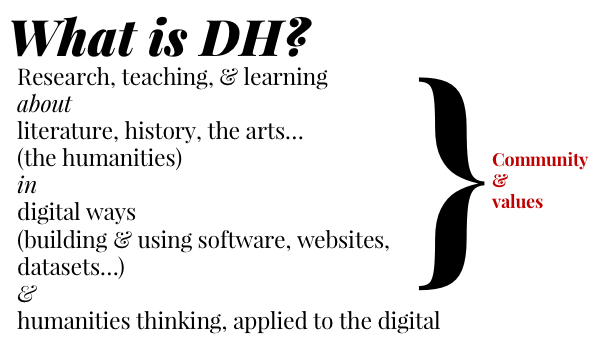
What is Digital Humanities


It is necessary to understand how digital humanities as a wider field is described as the new technology-driven tools and methods to traditional humanities disciplines such as literature, history, and philosophy. There upon Digital Humanities is


"The digital humanities, also known as humanities computing, is a field of study, research, teaching, and invention concerned with the intersection of computing and the disciplines of the humanities. It is methodological by nature and interdisciplinary in scope. It involves investigation, analysis, synthesis and presentation of information in electronic form. It studies how these media affect the disciplines in which they are used, and what these disciplines have to contribute to our knowledge of computing." 


Also termed as ‘humanities computing’, the editors of a companion to Digital Humanities who introduced the term abruptly in 2004 as an expansion of what was commonly referred to as' embracing the full range of multimedia’. 

In his book "The Emergence of Digital Humanities", Steven E. Jones explains that as a new model, DH emerged more or less concurrently with the new context associated with the new developments in technology of essays published online in 2004 and a hardcover book in 2005.  

Blackwell’s Companion to Digital label of convenience for the moment for what all humanists will be doing relatively soon as an umbrella term for a diverse set of practices and concerns, all of which join computing and digital media with humanities. 


We can see how written text can be converted into the digital form. So it can be easy to access the words, sentences and other things. which we want in a few minutes rather than to take much time.

Rafael Alvarado argues that we have a genealogy, a network of family resemblances among provisional schools of thought, methodological interests, and preferred tools, a history of people who have chosen to call themselves digital humanists  a social category, not an ontological one. 

He is supported by Matt of Digital Humanities survey as a ' term of tactical convenience’. Kirschenbaum in his essay ‘What Is Digital Humanities and What’s It Doing in English Departments?reminds us of the Humanities in 2004. 


Here, I have put down some of the questions that may be defined by what Digital humanities make humans. The new possibilities represented by digital for teaching and scientific research: how will these change the teaching of humanities? What contribution can humanistic cultural criticism make to the digital revolution? 

However, we also intend to reflect on Digital Humanities as a new disciplinary area, bringing out new questions: how to form the new figure of the digital humanist? What knowledge is called upon to define Digital Humanities as a field of study, research and training? How to recognize, classify, describe and evaluate research in the Digital Humanities sector?

For the moment, we know that Digital Humanities tries to model the world around us through success and failure in order to arrive at a better understanding of what we know and do not know about humankind.     

■ Benefits of Digital Humanities


  • Integration of qualitative and quantitative approaches -

You can present and interlink digitized text, images, and 
time-based media with maps, timelines, data, and visualizations. Which can help to easily understand and to healthy interaction.

  • Content management and data -

You can mine, map and reorganize the resources – whatever you need to uncover trends, themes and key learnings.

  • Quicker access to information through.         digital access - 

This means more people can review, see and learn from the project. You are also able to more easily search through the data, combine different data sources, hyperlink to relevant background materials, and more.if we have any difficulties in identifying meaning words or the real context of the picture we can easily access through it.

  • Enhanced teaching  - 

Digital Humanities helps students learn by being able to see more than the limitations of books and bondage of subject, experience more, and collaborate together. Which would be beneficial for 
them to enhance the learning process and skills.

  • Improved collaboration - 

Digital resources and environments can provide a common platform for project development, research, to create a new way to expand the collaborative ideas and group-sourcing of materials, and facilitate local, regional and global partnerships.

  • Public impact -

Education cannot be limited behind closed doors and blackboards. Smart classes are becoming a norm and teachers should consider the interactive method of teaching. Use of Google classroom, online quizzes, various groups, flipped learning, blogs etc. 

Opens up communication the projects extend beyond the classroom and make a public impact.  Not only does this help show the value of the study of Humanities, but digital projects can also help inform and engage those outside the university setting.

ðŸ’ŧ What’s Digital Humanities doing in 
English Departments?


Matthew Kirschenbaum is Professor in the Department of English at the University of Maryland and Director of the Graduate Certificate in Digital Studies. He is also an affiliated faculty member with the College of Information Studies at Maryland. 

He served previously as an Associate Director of the Maryland Institute for Technology in the Humanities (MITH) for over a decade.

As Matthew G. Kirschenbaum has given the five reasons why Digital humanities have had an impact on English Department as it goes along with it. Actually traditional text is not given all components which we want so the computer helps to make it easier to manipulate. 

  • First, after numeric input, text has been by far the most tractable data type for computers to manipulate. Unlike images, audio, video, and so on, there is a long tradition of text-based data processing that was within the capabilities of even some of the earliest computer systems and that has for decades fed research in fields like stylistics, linguistics, and author attribution studies, all heavily associated with English departments. 

  • Second, of course, there is the long association between computers and composition, almost as long and just as rich in its lineage. 

  • Third is the pitch-perfect convergence between the intense conversations around editorial theory and method in the 1980s and the widespread means to implement electronic archives and editions very soon after; Jerome McGann is a key figure here, with his work on the Rossetti Archive, which he has repeatedly described as a vehicle for applied theory, standing as paradigmatic. 

  • Fourth, and at roughly the same time, is a modest but much-promoted belle-lettristic project around hypertext and other forms of electronic literature that continues to this day and is increasingly vibrant and diverse. 

  • Fifth is the openness of English departments to cultural studies, where computers and other objects of digital material culture become the centerpiece of analysis. I’m thinking here, for example, of the reader Stuart Hall and others put together around the Sony Walkman, that hipster iPod of old.


🔚️ To wind up :-

The learning about code or other pieces of realizing a DH project, helps you understand issues, limitations, opportunities. We might not have seen otherwise understand why DH has treated some opportunities as low-hanging fruit and others as blue-sky wishes.

Digital Humanities neither a field, a discipline, nor a methodology. It is not simply the humanities done with computers, nor is it computer science performed on topics of interest to the humanities. DH is the result of a dynamic dialogue between emerging technology and humanistic inquiry. For some, it is a scholarly community of practice that is engaged in a wide variety of projects but that collectively values experimentation, collaboration, and making.

◾Citations 

  • Kozinets Robert V (1998) Book review of D. Owram’s Born at the Right Time, Historical Journal of Film, Radio and Television. 18(3) 455-457. 
  • “Bio.” Matthew G. Kirschenbaum, 13 Nov. 2018,
  • Kaplan FrÃĐdÃĐric, “A Map for Big Data Research in Digital Humanities.” Frontiers, Frontiers, 18 Apr. 2015,
  • Schreibman S, Siemens R, Unsworth J (2018) A Companion to Digital Humanities. Blackwell Publishing. Malden, MA, Oxford, and Carlton, Blackwell Publishing, Victoria, UK, pp. 28-611.
  • Steven E Jones (2013) The Emergence of the Digital Humanities London, Routledge, UK.
  • Alvarado R (2011) The Digital Humanities Situation. The Transducer.  
  • Matthew G Kirschenbaum (2010) What Is Digital Humanities and What’s It Doing in English Departments? ADE Bulletin, pp. 150.7.        

Issues of marriage and Inheritance in contemporary time reference to sense and sensibility


Paper No. - 1

  Romantic Literature.  

Name :- Dharti makwana 
Batch :- 2019-2021
Semester :- M.A. Sem-2
Roll No. :- 5
Enrollment No. :- 2069108420200024 
Submitted  :- Smt. S.B.Gardi Department      of English, M.K.Bhavnagar University 
Email :- dharteemakwana789@gmail.com 
Paper No. :- Romantic Literature 
Topic :- Issue of Inheritance and Marriage in contemporary time reference to Sense and Sensibility


Issues of Inheritance and marriage 

👉 Introduction:-

Jane Austen focuses on the legal situation of the English woman and marriage women in particular at a time when debate on Reform of the 'lady's law' was just beginning for the demand for 'reform of marital  and the property law' in the 1850s. There were substantial changes to English family law. Afterward still in the early nineteenth century patriarchal marriage and property law still controlled women's lives in concert ways.

It has never been a good time to be a woman. Shackled at home, deprived of rights in society, and subjected to gender bias at the workplace, women have borne the brunt of being the weaker sex all through history. Though the skew in rights and treatment hasn’t quite corrected itself, women are possibly in a better place today than ever before because in contemporary  time woman related laws are developed and stronger than ever in the past.

This is because rising awareness, availability of global forums and social media to voice their anguish and against, changes in laws to empower them, and proactive governments to implement gender neutral laws have all converged to give women a hearing and heft. Still, there are many areas that can do with a nudge to empower them, one being the succession and inheritance laws. For years, women in India have been discriminated against and denied the right to ancestral property due to various reasons. 

■ Marriage and Inheritance issues in Sense and Sensibility:-


One, there is no uniformity in inheritance laws, with various religious communities governed by their own personal laws and different state tribals by their customary laws.

However, Jane Austen in her work "Sense and 
Sensibility" is closer to the injustices of women
Especially the rejection of marriage for money rather than love, Austen also did not agree that women depend on economically-financial protection of man, so as not to look kindly on patriarchy and the merging of interests of the aristocratic and middle class.We know from chapter one that Henry Dashwood is the legal inheritor of the estate of Norland from his uncle, who was without issue. 

The day food family settled in Sussex and their state was large and they have all the residential facilities in North Land Park. Afterward the death of Mr. Dashwood and his son got all the property in inheritance. Because of it they had been left from that house. 

"Mr. Dashwood had wished for it more for the sake of his wife and daughters than for himself or his son; but to his son, and his son’s son, a child of four years old, it was secured, in such a way, as to leave to himself no power of providing for those who were most dear to him, and who most needed a provision, by any charge on the estate, or by any sale of its valuable woods. The whole was tied up for the benefit of this child.."


Much has been said of the power of attraction of the work of Jane Austen's Sense and Sensibility especially. The eighteenth century is a fascinating period of a gradually changing climate in political, cultural and social spheres of life. As David Cecil suggests, 

“Her books express a general view of life. It is the view of that eighteenth-century civilisation of which she was the last exquisite blossom. One might call it the moral-realistic view” (Cecil 1942: 115).

fictional representations of inheritance often perpetuate the image of unequal distribution. Many of Austen’s heroines, dependent upon marriage because their father’s homes and wealth are entailed upon a brother or male cousin, have typified this plight. Elinor, Marianne, and Margaret Dashwood of Sense and Sensibility

Inheritance and marriage issues of Ancient Time:-


The early Rig Vedic period society appears to be almost egalitarian—gender-wise. In this period, there was no individual ownership, but only community ownership of property and wealth, among the tribals. Women then would enjoy equal positions in the fields of education and were free to choose their life partners too. Women observed a high standard of morality and they were permitted to own jewelry and clothing. 

Also, after the death of a mother, property was passed on to daughters. Many women made a mark as renowned scholars and philosophers. A patriarchal system was followed in ancient India where, male domination was prevalent. Here, women were respected, revered and participated in religious ceremonies.

They were free to select their conjugal partner and exercised free-will in entering into the matrimonial bondage; in fact they even married at a mature age. Therefore women enjoyed a sense of justice in the sphere in public and private spheres. 

On the other hand, studies exhibit that a debate revolves around the status and position of women in the Vedic period. What is revealed is that, though women participated in the hymns, they were deprived from political rights and property inheritance rights. 

Their status was counted at the level of Shudra. Despite the other privileges they enjoyed, women in the Vedic period, could not own or inherit property. Only those who had the power to defend themselves from the enemies from the enemies could hold land as property. 

Obviously, women were lacking in such areas, which further deprived them of ownership. In Vedic society the birth of a son would be followed by rituals and prayers: even the pantheon consisted of only men. So, patriarchal was the society then that the birth of male child was believed to bring nirvana in the family. Agricultural practices were absent in the early Vedic period and land was not considered as an important asset. 

What was counted valuable was mostly pastoral: like cattle. It has been argued that if inter-tribal conflict for cattle, then the king would supposedly be the protector of cattle and not the land. The seed of private ownership of property emerged only in the post-Vedic period, with a pattern of patrilineal inheritance system. Vedas a sacred Hindu text in the Vedic period, later became the main source of Hindu law, along with customs and traditions of the tribal people. 

The idea of Inheritance in Dharmasastras :-


This Hindu ideology carries the ethos of patriarchal system. It likely exhibits women as a subservient and a dependent. This gives her very little scope for inheritance of property rights, in male-dominated society.Women were not entitled to inheritance and their position also get deteriorated due to the injunctions of religious texts such as Dharmasastras, Manusmiriti and other work of law-givers such as Jimutavahana along with Vijnanesvara. 

The introduction of Dharma Sutras and Sastras 
explicitly favoured male inheritance. If there was an absence of a son in the family, then property would be given to the male descendents. While dealing with Dharmasastra, Manu identified, two contradictory principles with regard to women’s property rights, because

  • On the one hand, women’s exclusive ownership of the property was obtained as gifts from relatives.

  • On the other side, only men were sole inheritors and women had no right to inherit parental property.

The tradition of men as sole inheritors further sidelined women's property rights. stridhana refers to property that women obtained from her relations, gifted to her at the time of marriage, by both sides of the family. It is also known as a bridal price. Sometimes unmarried daughters were given maternal property as stridhana, but they were not granted a direct inheritance share in the family.

🔷️ Marriage Act 

What will help power these is the increase in awareness 
among women and quick implementation of the laws. To 
help with the former, we list the inheritance and succession rights of women, be it a wife, daughter, mother or sister for the main religious groups in India.

  • Hindu Succession Act, 1956
Laws of succession apply to Hindus, Sikhs, Jains and Buddhists for the non testamentary or intestate succession and inheritance.

  • Indian Succession Act, 1925
Applicable to Parsis for intestate succession, specifically under Sections 50 to 56.

  • Indian Succession Act, 1925
Laws of succession applicable to Christians and Jews, specifically under Sections 31 to 49.

  • Muslim Personal Law (Shariat) Application Act, 1937
Laws of succession governing Muslims for non-testamentary succession. Where a Muslim has died with a will, the issue is governed by the Indian Succession Act, 1925, where a will relates to immovable property within the states of West Bengal, and that of Madras and Mumbai jurisdiction.
  • Special Marriage Act, 1954

Laws of succession in case of interfaith marriages hindus
  • The Hindu Succession Act, 1956

It governs the succession and inheritance laws for Hindus, along with Buddhists, Jains and Sikhs. This is applicable to both women and men. The Act makes no distinction between movable and immovable property. It only applies to intestate succession (where there is no will) and to anyone who converts to Hinduism. It has no application in case of testamentary succession. 

🔷️ Conclusion 
All of these complicated connections established by Jane Austen spring from wills and entailments governed by the inheritance laws of Regency England. It is obvious that wealth and inheritance weigh heavily on Jane Austen’s plots and characters; – its importance deeply shadowing each of her novels and the climate of the times.

Dashwood women have no money, they cannot inherit money because they are women, and they cannot earn a living. Since the girls have no money, money becomes an important factor when it comes to what men they may want to marry. Elinor Dashwood demonstrates her sense through what she says and thinks, her actions, and what Jane Austen says of Elinor. One way Elinor shows sense in what she says and thinks.

Citations 


  • Nirosha Hewa Wellalage, Stuart Locke, Helen Samujh. (2019) Corruption, Gender and Credit Constraints: Evidence from South Asian SMEs. Journal of Business Ethics 159:1, pages 267-280.

  • DE Smith, India as a Secular State, London: Oxford University Press, p 84.
  • HL Moore, A Passion for Difference: Essays in Anthropology and Gender, Cambridge: Polity Press, 1995.
  • Regan, Milton C. “Scholarship @ GEORGETOWN LAW.” Site, Mar. 2010,
  • Ablow, Rachel. The Marriage of Minds: Reading Sympathy in the Victorian Marriage Plot. Stanford: Stanford UP, 2007. Print.
  • Cornwallis, Cornelia Frances, “The Property of Married Women.” Westminster Review 66 old ser. (Oct. 1856): 181-97. Print.
  • Jill Rappoport, “Wives and Sons: Coverture, Primogeniture, and Married Women’s Property”
  • Rapport, Jill. “‘Wives and Sons: Coverture, Primogeniture, and Married Women's Property.’” BRANCH, July 2012,
  • Nattress, Laurel Ann. “Puzzling Legal Nonsense in Austen's Sense and Sensibility.”Google, 2008,

Gift of Chappals std 7 ch- 2 Honeycomb

  PPT   Gift of Chappals Quiz